
October Occasions
Options & Opportunities
The Significance of Tihar
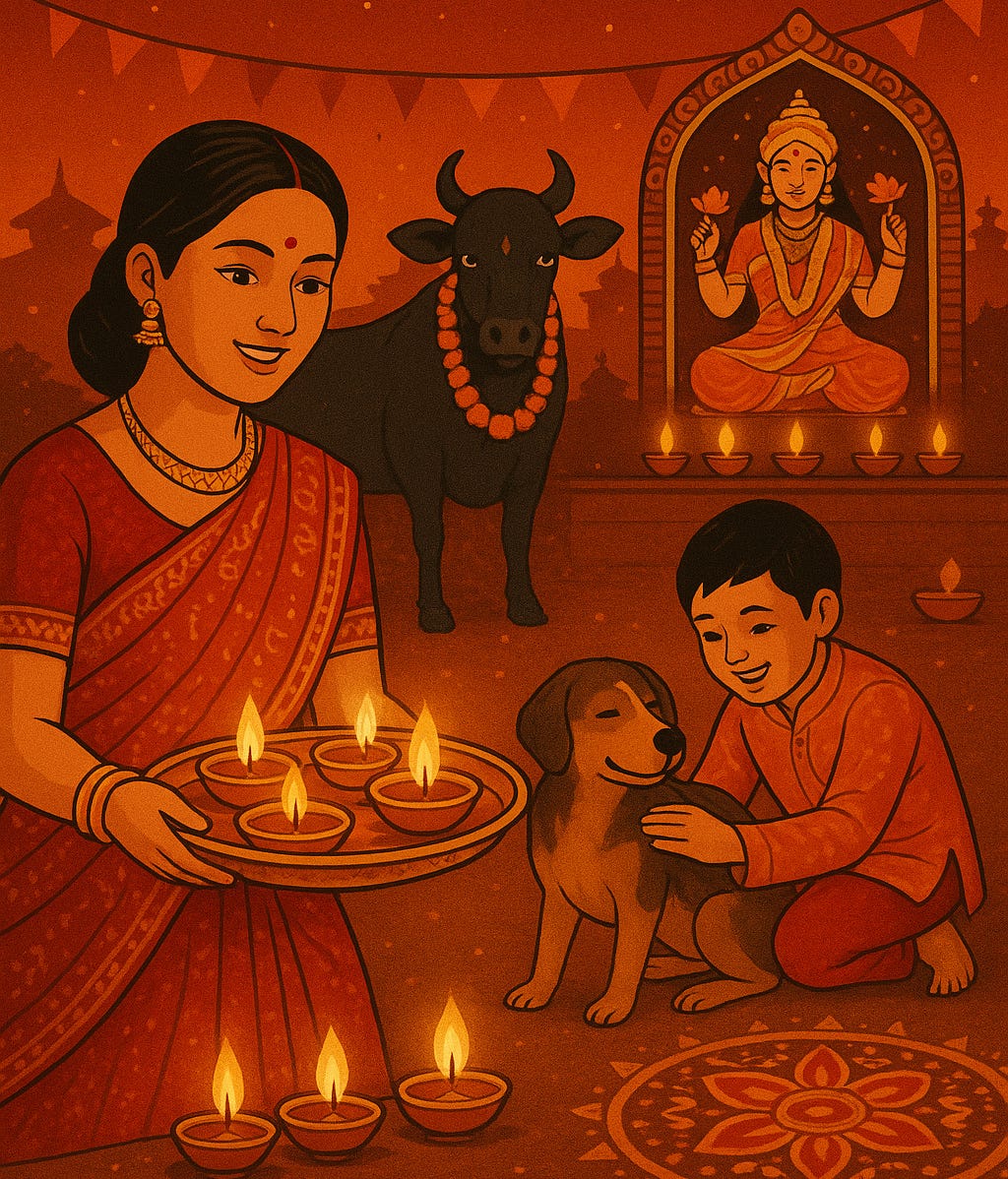
The five days of Tihar, also known as Yama Panchak or the festival of lights, is one of the most beautiful and significant festivals in Nepal. Its significance goes beyond just the celebration of lights; it is a profound expression of culture, religion, and the harmonious relationship between humans, nature, and the divine.
Each day has a unique focus and ritual, building towards a complete celebration of life’s various aspects.
Here is the significance of each of the five days:
Day 1: Kaag Tihar
Significance: Crows are considered the messengers of death and the link to the underworld in Hindu mythology. They are also believed to be the vehicle of Shani (Saturn), the god of justice. By worshipping and feeding crows, people seek to avert grief, bad news, and misfortune for the coming year. It is a gesture to please Yama, the god of death, and ensure he does not send any sad news.
Rituals: A special offering of food (often a mixture of rice, yogurt, and sweets) is placed on a platter or on the roof for crows to eat.
Day 2: Kukur Tihar
Significance: This day honors the dog, which holds a sacred place in Hindu lore. Dogs are seen as the guardians of the underworld and the vahana (vehicle) of Bhairava, a fierce form of Lord Shiva. Furthermore, the dog is believed to be a loyal companion to Yama. This day celebrates the deep bond of loyalty and friendship between humans and dogs.
Rituals: Dogs—both pet and stray—are honored. They are adorned with garlands of marigolds (mala), a tika (a mark of vermilion and rice) is applied on their foreheads, and they are offered delicious food as a sign of respect and gratitude.
Day 3: Gai Tihar and Laxmi Puja
This is the most elaborate and central day of the festival.
Gai Tihar (Cow Worship):
Significance: The cow is revered as the national animal of Nepal and is considered a sacred mother figure (Gai Mata) in Hinduism. It symbolizes wealth, prosperity, and nurturing. The cow is also the vehicle of Goddess Laxmi.
Rituals: Cows are worshipped similarly to dogs—garlanded, offered a tika, and fed special treats like fresh grass, fruits, and sel roti (a traditional Nepali rice doughnut).
Laxmi Puja (Worship of Goddess Laxmi):
Significance: The evening of the third day is dedicated to Goddess Laxmi, the deity of wealth, fortune, and prosperity. It is believed that on this night, she visits every home that is clean, bright, and inviting to bless it with abundance for the coming year.
Rituals:
Cleaning and Decorating: Homes are thoroughly cleaned and decorated.
Lights (Diyo): The entire house is illuminated with oil lamps (diyos), candles, and electric lights to guide Goddess Laxmi inside.
Mandala: Intricate and colorful patterns made from colored powders, rice, and flowers are drawn on the ground at entrances to welcome her.
Puja: A formal worship ceremony is performed, and a special Bhailo tradition sees groups of children and young people sing and dance door-to-door, receiving money and food in return.
Day 4: Goru Tihar, Govardhan Puja, and Mha Puja
This day has different significances for various communities.
For most Hindus (Goru Tihar & Govardhan Puja):
Significance: This day is dedicated to the worship of the ox (Goru), a vital animal for plowing fields. It also commemorates the day when Lord Krishna lifted the Govardhan Hill to protect the people of Vrindavan from the wrath of Lord Indra, the god of rain and storms. Thus, it symbolizes the worship of nature and agriculture.
Rituals: Oxen are worshipped, and a mound of cow dung representing Govardhan Hill is made and worshipped.
For the Newar Community (Mha Puja):
Significance: Mha Puja translates to “worship of the self.” It is a unique and profound ritual that celebrates the divine spirit within every individual. It marks the first day of the Newar New Year (Nepal Sambat). The ritual signifies self-realization, purification, and the renewal of one’s own physical and spiritual being for the year ahead.
Rituals: Family members sit in a row on the floor. A complex mandala is drawn for each person, and a ritual plate (Sagan) with specific items (egg, fish, wine, bread, etc.) is presented. The ritual involves lighting a wick on a walnut oil lamp, symbolizing the illumination of the soul.
Day 5: Bhai Tika
Significance: This is the final and emotionally charged day of Tihar. It celebrates the sacred bond between brothers and sisters. The ritual is based on the legend of a sister who desperately pleaded with Yama, the god of death, to not take her brother’s life. She performed a special ceremony with tika and flowers, eventually winning a boon from Yama that any brother whose sister worships him in this way on this day will be granted long life and prosperity.
Rituals:
Sisters prepare a special puja plate.
They create a protective barrier of mustard oil and a circular ring of Makhamali (Gomphrena globosa) flowers around their brother.
They apply a special, long tika with seven colors (Saptarangi Tika) on the brother’s forehead, representing their prayers for his long life, health, and success.
In return, brothers give gifts and promise to protect their sisters throughout their lives. They also apply a tika to their sisters.
Overall Significance of Tihar:
A Celebration of Interconnectedness: Tihar beautifully illustrates the Hindu belief in the sacredness of all life forms—from crows and dogs to cows and oxen—and our dependence on them.
Triumph of Light over Darkness: Like Diwali in India, it symbolizes the victory of knowledge over ignorance and good over evil.
Strengthening Relationships: It reinforces the bonds of family, particularly the unique bond between siblings on Bhai Tika.
Cultural Identity: It is a cornerstone of Nepali identity, uniting the country in a shared celebration of its rich cultural and religious heritage.
Events & Programs
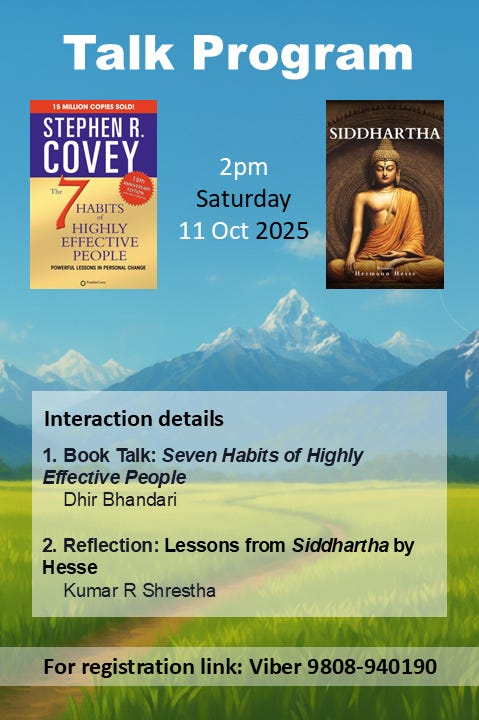
Kathmandu Meditates
Physical: Mind Body Center, Babarmahal
Online: Google Meet
All levels welcome |Energy Exchange Rs.108
Universal Meditation Journey
A gentle, guided meditation series rooted in timeless wisdom to help you manage daily stress, find your inner peace, and connect deeply with yourself and the world around you.
Bring notebook and pen to journal
Limited seats available.
Untangling Myth from Reality
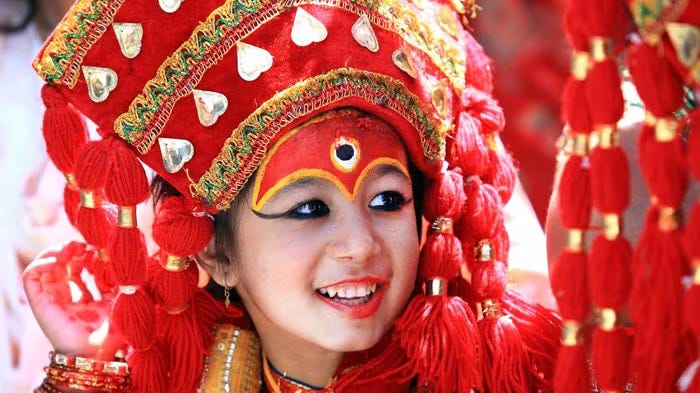
The Kumari of Kathmandu, the revered living goddess, exists at the crossroads of divine faith and human curiosity. Shrouded in the mists of ancient tradition and sequestered within her palatial home, she has become a figure enveloped in legend. For outsiders and many Nepalis alike, the line between sacred ritual and sensationalized folklore is often blurred. Whispers of a cursed life, tales of supernatural selection, and assumptions about her imprisonment have woven a complex narrative that sometimes obscures the true nature of this profound tradition.
This section seeks to move beyond the mystery and separate the enduring myths from the documented facts. By examining the most common misconceptions, we can foster a deeper, more respectful understanding of the Kumari—not as a mythical creature, but as a young girl at the heart of a living, evolving cultural and spiritual practice. We will explore what is truly known about her selection, her daily life, and her transition back to the mortal world, contrasting the popular legends with the realities experienced by the Kumaris themselves.
MYTH 1: The Kumari is an exclusively Hindu or Buddhist deity.
FACT: The tradition is a unique synthesis of Hinduism (Goddess Taleju) and Vajrayana Buddhism (Vajradevi), specific to the Newar people.
MYTH 2: The Kumari is selected through supernatural feats like identifying past belongings.
FACT: Selection is based on meeting 32 strict physical perfections and passing a final “Courage Test” involving remaining calm among ritual buffalo heads and masked men.
MYTH 3: The Kumari is imprisoned in her palace.
FACT: She lives in the Kumari Ghar with her family, appears at her window for devotees, and is taken out for many public festivals throughout the year.
MYTH 4: The Kumari is uneducated.
FACT: She receives a formal education from a private tutor provided by the state within her palace.
MYTH 5: A man who marries a former Kumari will die young.
FACT: This is a false superstition. Many former Kumaris have married and have healthy, long-lasting marriages.
MYTH 6: The Kumari must never show emotion, and if she does, it is a bad omen.
FACT: While she maintains composure during public ceremonies, she is a child who laughs, cries, and plays in private. The “omen” belief is a folk tale, not strict doctrine.
MYTH 7: The Kumari of Kathmandu is the only Living Goddess.
FACT: Cities like Patan and Bhaktapur have their own Royal Kumaris, and there are other lesser-known Kumaris in local neighborhoods.
MYTH 8: Her life after retirement is doomed and tragic.
FACT: While reintegration is challenging, former Kumaris receive a state pension, and modern efforts ensure they receive educational and social support to lead successful lives.
MYTH 9: Her tenure ends only at her first menstruation.
FACT: Her term also ends with the coming of age or with any significant, accidental loss of blood (e.g., a major cut.)
Food Distribution for Orphans
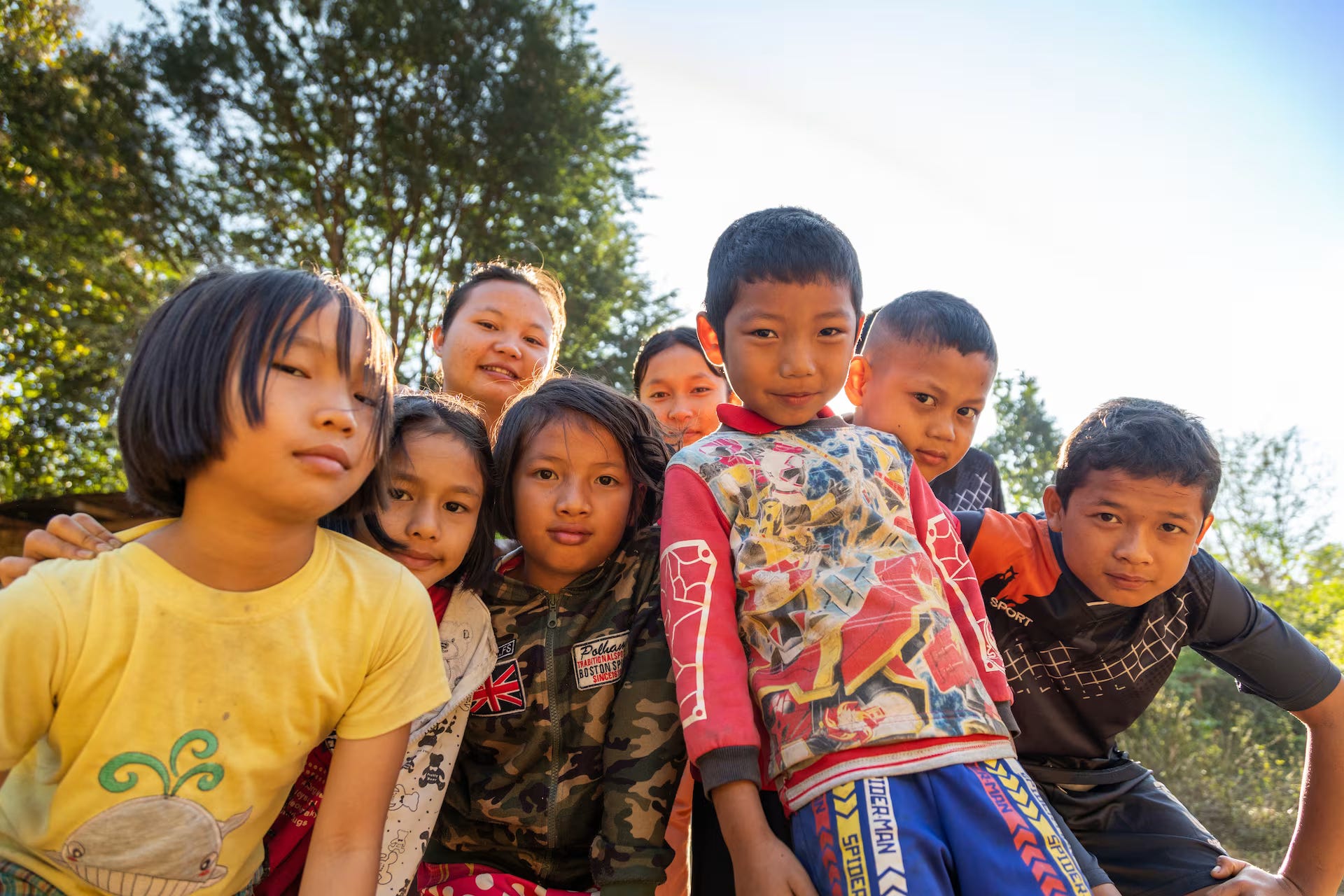
Let’s join our helping hands to cook or feed children living in orphanages.
Program will be on a Saturday afternoon.
To confirm your participation, please call 9841-896000
